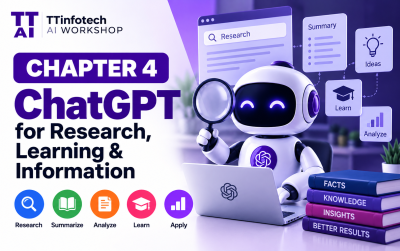
Chapter 4 — ChatGPT for Research, Learning & Information
### Chapter 4: ChatGPT for Research, Learning & Information
Discover how to use ChatGPT as a powerful **research and learning assistant**. In this chapter, students will learn how to research topics, understand complex information, summarize long content, compare ideas, organize information, and turn knowledge into practical outputs.
Students will also learn how to ask better research questions, provide context, break complex topics into simple explanations, create study materials, and use follow-up prompts to improve results.
The chapter emphasizes **critical thinking and verification**, helping students understand that AI-generated information should be reviewed and important facts should be checked before being trusted or used.
By the end of this chapter, students will be able to use ChatGPT more effectively for **education, research, assignments, professional work, analysis, and everyday information needs**.

Students will understand the fundamentals of ChatGPT, learn its key capabilities and limitations, and gain the foundation needed to use AI effectively for learning, productivity, content creation, and professional tasks.
Requirements
Basic computer knowledge, internet connection, and a ChatGPT account. No prior AI or programming experience is required.
Frequently asked question
ChatGPT can help brainstorm research topics, explain concepts, organize information, summarize material, and suggest questions to investigate.
Yes. You can ask ChatGPT to explain a complex topic step-by-step or at a beginner-friendly level.
Yes. You can provide learning material and ask ChatGPT to create summaries, revision notes, key points, or flashcards.
Yes. ChatGPT can summarize provided text and organize the main ideas into concise points.
Yes. You can ask it to compare topics using a table, similarities and differences, advantages and disadvantages, or other formats.
Yes. It can generate practice questions, quizzes, explanations, revision plans, and mock tests
No. Important facts, statistics, references, and claims should be independently verified.
Give ChatGPT a clear research goal, relevant context, specific requirements, and the desired output format.
Yes. It can help organize information into sections such as introduction, key findings, analysis, conclusion, and recommendations.
Students learn to use AI as a research and learning assistant while maintaining critical thinking and verifying important information.